Showing posts with label zF Mastering Our Emotions. Show all posts

Sunday, December 11, 2011

Trust in Yourself - Hear No Evil


Once upon a time, but not long ago, there lived a happy colony of frogs in a pond rich with food and spring water.

Unfortunately, due to the effects of global warming and climate change, the pond started to slowly dry up. Food became scarce and the water became a sticky slimy mix of mud and dirt.

The frogs began to fall sick one by one, and disease started to spread across the once healthy colony. The frogs started to panic, they had to leave the pond or all are doomed to die a slow and agonising death on the parched river bed.


So one day, it was the time for the great migration. The entire colony of several hundred frogs set off to the “promised pond” flowing with pristine mountain stream water and teeming with juicy worms and delicious, crunchy beetles and dragon flies.

As soon as the journey started, one frog complained, “Why do we have to choose such a sizzling hot day to start our journey?”

Indeed, not only was the weather hot, the ground was hard and peppered with sharp stones. The sharp stones cut painfully into the tiny feet of the frogs. “Why did we choose such a difficult route?!” grumbled another frog.

Soon, murmurings of many questions with no easy answers spread across the entire colony. The murmurings got louder…. and… LOUDER.

Finally, the inevitable happened.

The first frog stopped. “This journey doesn’t make sense at all”, it proclaimed. Then another frog stopped. “This journey isn’t worth the trouble”, echoed another.

“Let’s just go back”, declared another. One by one, the frogs stopped.

All, but one

One tiny frog just continued when every frog had stopped. It pressed ahead, further, and further from the chattering crowd, one painful hop at a time.

It struggled down a deep valley, and then painfully made its way up a steep, rock cliff to arrive at the golden pond on the other side.

The colony of frogs was watching from their side of the hill. They shouted at the top of their voices and waved their feet frantically at the little frog to turn back. But it was all in vain.

The entire colony was amazed, and in awe. Every frog was wondering what special powers this little one had that helped it overcome such incredible huddles.

Then a cousin of the little frog revealed to the colony that his little frog cousin was…. well…. deaf!

It quickly dawned on the colony that the little frog had no special powers at all. It was just deaf and oblivious to all the self defeating talk and thoughts of the colony.

Dear friends, have you had the experience of abandoning your dreams and plans because of the negative voices you heard?


Who is the loudest naysayer in your life?

For many of us, that very person is none other than, WE, ourselves.

For many of us, the loudest, negative voice come from inside us. Compared to our own negative voice, even the devil is sometimes kinder.

All of us have two voices in our head. The critical, negative voice, and the supportive, positive voice.

In order not to abandon our dreams like the frogs, we need to trust our positive, supportive voice.

We need to trust in our way of thinking, for that gives us the confidence to be creative in thinking up new ideas.

We need to trust in our ability, for that gives us the confidence to take bold action.

We need to trust in our purpose, for that gives us the confidence to stay committed in the face of huddles that will inevitably stand in the way of achieving our dreams.

So my dear friends, be like the little frog, be deaf to the negative voices that discourage you from your goals. Trust instead in your thinking, ability, and purpose.
Good luck!

Sunday, October 9, 2011

The Power of Visualization: Onami the Great Wave!


Onami was a powerful sumo wrestler who lived in Japan about 100 years ago.

Onami was so strong and skilful that he was able to beat his own teachers during wrestling matches in private training. Indeed, Onami never ever lost a practice match.

However, Onami has a problem of stage fright. Crowds made Onami nervous.

He was unable to perform at his best during public matches in front of large audiences. During public matches, Onami was beaten even by his own students and also by untalented wrestlers only half his size. Onami’s stage fright became so serious that he lost twenty consecutive matches.

Troubled by his stage fright problems, Onami consulted a wise Zen master.

The Zen master told Onami, “Your name means Great Wave. Imagine you are a Great Wave. Visualize yourself sweeping your opponents aside like a powerful unstoppable wave.”


Onami did as the Zen Master said. He spent the days and nights visualising himself as the Great Wave, an earth shaking wave, big as the ocean itself, sweeping his opponent aside with great unstoppable power.

When the day of the competition came, Onami went into the ring of a public match with this mental movie of himself as the Great Wave. The moment the referee started the fight with the wave of the fan, Onami the Great Wave surged forward with tremendous power. He swept his opponent away with an unstoppable shove.

Visualisation is a powerful yet simple method to manage your feelings and your body for peak performance when facing acute challenges such as during a crucial contest, final examinations, or during public speaking.

For example, when making an inspirational speech, imagine in detail that you are Martin Luther King. When playing goalkeeper during a soccer match, imagine in detail that you are a cat. You can imagine anything you want as long as it gives you power.

Try it, you will be amazing.

Saturday, May 14, 2011

Follow your Heart


You have heard the phrases “Trust your gut”, “Listen to your heart”.

Most of us are conditioned to dismiss what our gut tells us, and would rather “use our head” to think logically and rationally instead.

We are conditioned to think that "using our head" is a sign of maturity. Only the feeble minded, let their heart and gut "mislead" them.

It may surprise you to learn that modern neuroscience has discovered that following our gut or our heart may not be so far fetched or frivolous after all. Neuroscience has validated what the ancients from across the world had understood all along. Neuroscience has confirmed that the ancients’ belief that the heart and gut have a mind of their own is not a misunderstanding of the human anatomy. Trusting in our heart and gut has basis in how the human mind works.

First, let me ask “Where is our brain”?

Many would say that our brain sits on top of our shoulder, inside our skull.

While it is true that our brain has the highest concentration of nerve cells in our body, nerves cells are spread throughout our body. Besides our head brain, our intestines and stomach, and our heart also have high concentrations of nerve cells. Like our head brain, our gut and heart are truly equipped to think and feel.


Neuroscientists estimate that the nerve cells concentrated in our gut have about the same capacity as a cat’s brain. Hence, our “gut feel” has basis in neuroscience.

In 2002, there was a case of a heart transplant recipient reporting a new found love of certain kinds of music and food, and the memory of certain places which he had never experienced before, prior to the transplant.

The heart transplant recipient’s new tastes remained a mystery until it was revealed that the heart donor was a music and food connoisseur and adventurer, and had loved those music, food and places reported by the transplant recipient.

It seemed that the loves and passions of the heart donor were stored in his heart and they were now transferred to the transplant recipient along with the donated heart.

So listen to your heart, it truly has a mind in its own right. Give your heart a voice in your decision making that it deserves, as your cognitive brain in your head is not the only seat of intelligence that you have.

Following your heart is not a sign of feeble mindedness. Indeed, it is a mark of true wisdom.

Wednesday, April 6, 2011

Master Your Unconscious Mind to be a Master Persuader


Our mind is made up of two parts, namely, our conscious mind and our unconscious mind.

Our conscious mind has a very small capacity of only 7 bits of information at any moment. When we set an objective, we are using our conscious mind.

Our unconscious mind is the store house of our memories, beliefs, values, emotions, and attitudes. Everything that had ever happened to us, everything that we have seen, heard, or thought about is stored here. Compared to our conscious mind, our unconscious mind is infinite in size.

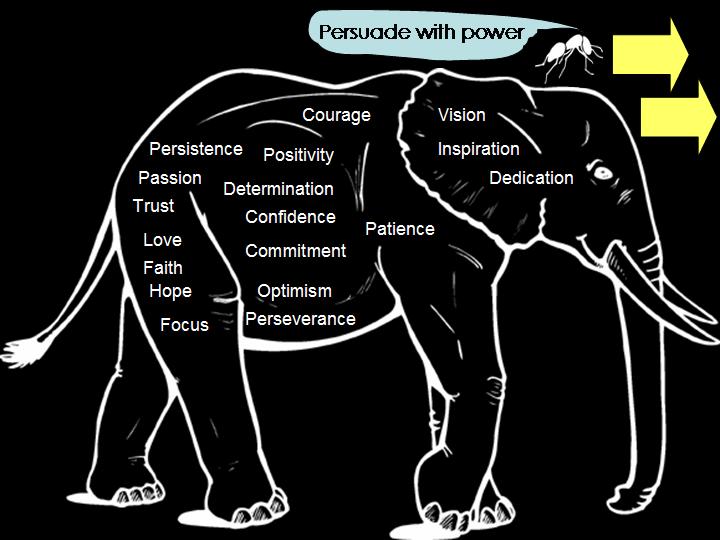
If our conscious mind is like an ant in size, then our unconscious mind is like an elephant. (Vince Poscente used this metaphor in his book The Ant and the Elephant, and in his trainings.)

Imagine an ant, riding on the back of an elephant. It doesn’t matter where the ant wants to go, it would not get there, if the elephant is not going the same way. Let’s say the ant wants to go to the east. No matter how hard and fast the ant walks, if the elephant is walking to the west, the ant will only end up further from his destination.

So, if we want to persuade with power, our unconscious mind must be filled with thoughts associated with passion, faith, and vision. We will not be persuasive, if our unconscious mind is filled with negative thoughts associated with apathy, fear, and hopelessness.

When our words and actions are congruent with our inner world, we will be more persuasive as we are more authentic, credible, and charismatic.

Sunday, January 23, 2011

What We Think, We Become


Let me share with you another parable about our unconscious mind.

A Cherokee grandpa was sharing with his grandson about life. "A fight is always raging inside my mind," he told the boy.

"Two wolves are locked in a terrible struggle, tearing at each other’s throat.”

“One is the bad wolf - he is anger, envy, regret, greed, arrogance, resentment, jealousy, vengeance, deceit, pessimism, and unthankfulness."

"The other is the good wolf - he is joy, peace, love, hope, humility, kindness, empathy, generosity, compassion, strength, integrity, gratitude, optimism, and faith.”

“The same fight is also always going on inside you - and inside every other person, too."

The grandson wondered for a moment and then asked his grandpa, "Which wolf will win?"

The old Cherokee replied, "The one you feed."

Ralph Waldo Emerson said, "A man is what he thinks about all day long."

When we fill our minds with negative thoughts, we are feeding our “bad wolf” and starving our “good wolf”.

If we want positive results, we must feed our “good wolf” by thinking positive thoughts.

Positive or negative thoughts – the choice is entirely ours. So choose your thoughts wisely – refuse to feed the big “bad wolf”.

Wednesday, July 7, 2010

Good Luck or Bad Luck, Too Soon to Tell

Once upon a time in ancient China, there lived an old man and his son who was in his twenties. Father and son tilled the field with their trusty but old and frail horse. This white horse had been part of the family for over ten years, toiling together without complaint with father and son for just a handful of oats every day. Father, son and horse were very attached to one another.

You can imagine the father and son’s dismal when one day, old faithful suddenly bolted towards the hills and disappeared over the horizon. The son chased after the horse but it was too late.

The son threw up his arms in despair, staring at the hills far away, and cried out: “What bad luck! What are we to do now? We have nothing to help us work the fields.”

The old man looked at his son with steady eyes and calmly mused: “Bad luck or good luck, too soon to tell.”

The old man then went to look for ways to plough the field without their horse.

A week had passed since old faithful ran away. Father and son were in the fields working the soil with hoes and their bare hands. It was back breaking work under the scorching sun.

They then heard that familiar neigh in the distance. When they looked up, they saw old faithful on a ridge trotting slowly at first and then galloping towards them.

Old man and son next heard the thunderous hooves of a dozen horses. To their amazement, ten wild horses followed old faithful and ran towards the old man and son’s farm. The herd of wild horses stopped at the farm and were contented to graze on the green, juicy grass.

The wild horses looked young and strong. Their teeth were white and clean. Their eyes were bright. Their thighs were well toned and there was a shiny, healthy sheen on their hide.

When the neighbours saw what happened, they were envious of the old man’s good fortune. They said: “You are such lucky people. Now you have more than ten good and strong horses to work the fields for you.”

The old man smiled politely and said: “Good luck or bad luck, too soon to tell.”

A few days later while the son was taming one of the wild horses, the black stallion stood up on its hide legs and punched its front legs in the air like a boxer - while the son was still on the saddle! The horse’s prancing antics threw the son off its back. He seemed to fly through the air for a moment before falling to the ground like a sack of potatoes with a loud thump!
The son landed on his buttocks. He let off such a loud, shrill, piercing scream that his neighbours could hear and feel his pain from hundreds of metres away . The pain was excruciating. When the neigbhours reached him, they found the son on the ground wrying in agony.

The villagers rushed the son to the doctor and he confirmed that the fall had broken the son’s hip. He was lucky that his neck was not broken.

“What bad luck!” the son cried out. The villagers who knew what happened to the son, took pity on him. "What an unfortunate accident" they said. But the old man remained serene and unfazed. He again mused: “Bad luck, good luck, too soon to tell.”

While the son was still bed ridden, war suddenly broke out with the barbarians in the north. The emperor’s army marched into the village and conscripted all the able bodied young men in the village for the war.
The old man’s son was spared as he could not even stand up with his broken hip.

The war went badly for the emperor and all the young men from the village did not survive to come home.

The old man and his son became the only people left to work the fields of the entire village. Yes, with the help of their ten horses and old faithful.

Is this good luck, or bad? Again the old man said: “Good luck, bad luck, too soon to tell.”

The puzzled and bewildered villagers finally asked the old man to explain his trademark remarks.
The wise old man replied: “Life is like this. Sometimes things that looked bad at first may later turn out to be a blessing in disguise.

Knowing this, it’ll serve us well to look for opportunity in every crisis.

Instead of wallowing in self pity when met with setbacks, ask what benefits can I get out of my current predicament. Ask "What is this an opportunity for?" With this mindset, you’ll find that any bad luck will turn to good luck.

Things happen, and it is what we do with what happens to us that makes the difference.

So the next time something momentous happens to you, stop and pause a moment to choose your course of action instead of letting the situation you are in determine your feelings, and thus your actions.

In the same way, when our situation is rosy, remember that there is danger in every good fortune. Be alert to dangers when things are going well. Don’t be caught off guard, like my son who was thrown from his favourite horse."

"Ah yes" the villagers agreed in unison. 

"Good luck, bad luck, too soon to tell.”