Showing posts with label zD Leveraging on Positive Attitudes. Show all posts

Sunday, December 11, 2011

Trust in Yourself - Hear No Evil


Once upon a time, but not long ago, there lived a happy colony of frogs in a pond rich with food and spring water.

Unfortunately, due to the effects of global warming and climate change, the pond started to slowly dry up. Food became scarce and the water became a sticky slimy mix of mud and dirt.

The frogs began to fall sick one by one, and disease started to spread across the once healthy colony. The frogs started to panic, they had to leave the pond or all are doomed to die a slow and agonising death on the parched river bed.


So one day, it was the time for the great migration. The entire colony of several hundred frogs set off to the “promised pond” flowing with pristine mountain stream water and teeming with juicy worms and delicious, crunchy beetles and dragon flies.

As soon as the journey started, one frog complained, “Why do we have to choose such a sizzling hot day to start our journey?”

Indeed, not only was the weather hot, the ground was hard and peppered with sharp stones. The sharp stones cut painfully into the tiny feet of the frogs. “Why did we choose such a difficult route?!” grumbled another frog.

Soon, murmurings of many questions with no easy answers spread across the entire colony. The murmurings got louder…. and… LOUDER.

Finally, the inevitable happened.

The first frog stopped. “This journey doesn’t make sense at all”, it proclaimed. Then another frog stopped. “This journey isn’t worth the trouble”, echoed another.

“Let’s just go back”, declared another. One by one, the frogs stopped.

All, but one

One tiny frog just continued when every frog had stopped. It pressed ahead, further, and further from the chattering crowd, one painful hop at a time.

It struggled down a deep valley, and then painfully made its way up a steep, rock cliff to arrive at the golden pond on the other side.

The colony of frogs was watching from their side of the hill. They shouted at the top of their voices and waved their feet frantically at the little frog to turn back. But it was all in vain.

The entire colony was amazed, and in awe. Every frog was wondering what special powers this little one had that helped it overcome such incredible huddles.

Then a cousin of the little frog revealed to the colony that his little frog cousin was…. well…. deaf!

It quickly dawned on the colony that the little frog had no special powers at all. It was just deaf and oblivious to all the self defeating talk and thoughts of the colony.

Dear friends, have you had the experience of abandoning your dreams and plans because of the negative voices you heard?


Who is the loudest naysayer in your life?

For many of us, that very person is none other than, WE, ourselves.

For many of us, the loudest, negative voice come from inside us. Compared to our own negative voice, even the devil is sometimes kinder.

All of us have two voices in our head. The critical, negative voice, and the supportive, positive voice.

In order not to abandon our dreams like the frogs, we need to trust our positive, supportive voice.

We need to trust in our way of thinking, for that gives us the confidence to be creative in thinking up new ideas.

We need to trust in our ability, for that gives us the confidence to take bold action.

We need to trust in our purpose, for that gives us the confidence to stay committed in the face of huddles that will inevitably stand in the way of achieving our dreams.

So my dear friends, be like the little frog, be deaf to the negative voices that discourage you from your goals. Trust instead in your thinking, ability, and purpose.
Good luck!

Tuesday, October 25, 2011

Know What You Fear to Overcome Fear


The ancient Greek god Pan was a half man, half goat being. He stood on two beefy hairy legs, had a human torso, a human face, and had the twisted horns of a goat.

Besides, his unique looks, Pan was known for two things. Firstly, he was lecherous and spent most of his time seducing the pretty goddesses and fairies. Secondly, Pan was also wickedly playful and mean.

Pan lived in the forests among the rolling hills and plains of the beautiful Greek countryside. Whenever he was bored, that is, without his female company - he would amuse himself by playing tricks on wary travellers at night. When the tired travellers were trudging through the dark valleys on dark moonless nights, Pan would rustle the bushes and make strange noises.

The poor travellers would imagine that there were wild and ferocious animals stalking them, about to pounce on them from the bushes. They would be so frightened that they would run for their lives. This state of great terror of something unknown, imaginary, and false is known as, panic, after the Greek god Pan.

This reminds me of the time I was a young officer in the Singapore Air Force’s Tengah Air Base back in 1981.


Tengah Air Base had a very long and proud history. It was from Tengah that the British Royal Air Force defended the Empire during World War Two. In turn, the Japan Army Air Force ruled the skies for the Emperor from Tengah during the Japanese occupation. After the war, Tengah resumed its role as the centre of British air power until it was handed over to the Singapore Air Force.

When officers sat down to chat, the topic very often drifted to ghost stories of Tengah’s past residents. Stories of torture, executions, and pilots who never returned from their missions. People remembered which unlucky colleague had lived in which room. We traded stories of strange sightings and unusual noises.

When we returned to base at night, there was a 15 minute walk between what was known as the West Gate and the Officer’s Mess. The walk took us through a golf course with rolling greens and ancient giant trees. At that time, the base was undergoing massive and rapid rebuilding. Most of the lights had been removed for the reconstruction. And every time we returned to base after the weekend, the landscape would have changed. Trees would dug up or roughly hacked leaving grotesque shapes in the dark. Gaping holes would be dug out where there was none just before the weekend. The excavators and cranes would look like menacing monsters in the dark. When the wind blew, the leaves would shake angrily and their long shadows would dart here and there unpredictably.

My imagination would mix these shadows and sounds with the ghost stories I heard. My heart would pound, I started to sweat, my walking pace would pick up. As I walked, more and more strange shadows would appear and I would hear more unexplainable sounds. Suddenly, I would pick up my pace and dash until I reached the relief of bright lights of the mess.

That my friends, is the sheer panic that the poor victims of Pan felt.

Someone said that panic or fear is nothing but False Evidence Appearing Real.

So if fear is False Evidence Appearing Real that means we ourselves created it, and it usually comes from the unknown.

But some fears are real. When we see a car coming towards us, we better feel fear, and we better get out of the way, fast!

But how much of our fears are created by the rustles and noises that Pan is playing tricks on us with?

Are you afraid of what might be there, rather than what is really there?

A common False Evidence Appearing Real is the fear of failure.

Goran Ericsson former manager of the England football team once said, “The greatest barrier to success is the fear of failure.”

Paraphrasing US President Franklin Roosevelt’s inaugural address, “There nothing to fear but fear of False Evidence Appearing Real”.

Failure hasn’t happened yet, but just the fear of imagined failure is enough to stop people in their tracks. Or lower their aim. Take a safer route.

Imagine if Columbus was fearful of falling off the edge of the earth, where is America today? If Steve Jobs was afraid that people might not appreciate the iPhone, would Apple ever be the world’s largest company?

My friends, next time you hear rustles in the bushes at night. Before you run off in panic, shine a light on it, check out what it is. Maybe it is a tiger and you better run. Maybe it is nothing more than False Evidence Appearing Real.

Friday, April 15, 2011

It Pays to be Honest in Celebrating Your Uniqueness

When you want to be persuasive, consider if it pays to face up to your flaws squarely up front. This way you gain the trust of your audience, and turn your weakness to your advantage.

The advertising campaign of the Volkswagen Beetle when it was first launched in the US was based on this principle. The Beetle was cheap, reliable and fuel efficient, but good looks was certainly not one of its selling points.


Instead of pushing the merits of its looks, or trying to divert attention to its mechanical merits, the Beetle’s marketeers flaunt its unconventional looks.

The company promoted the Beetle’s unique look with wacky tag lines like:

          “It will stay uglier longer”

          “Ugly is only skin deep”

Once the customers can get pass its looks, the Beetle’s mechanical and economic virtues sold by themselves. Before long, the Beetle became a much sought after car because of its distinctive look, and remained so till today.

I can think of another example, again from the automotive industry.


The tiny Morris Mini was created at a time when good sized cars with spacious, roomy cabins were the norm.

Instead of competing with the “normal” cars on size, the Mini touted its minuscule size as a virtue.

Like the Beetle, the Mini turned its biggest shortcoming into its selling point, was a sensational success, and remained a trendsetter till this day.

The Beetle and Mini became cultural icons because they dared to celebrate their uniqueness instead of cowering in self doubt.

Wednesday, April 6, 2011

Power Persuaders have the 3-Wins Mindset


The 3-wins power persuader seeks to get a win for self, the other person, and the larger group that both belong to.

In the context of an office, a 3-wins result would be a benefit for yourself, your colleague, and your company.

In the context of a company, a 3-wins outcome would be gains for the company, the customer, and the world in which they both exist.

In the context of a family, a 3-wins result would be a happy outcome for yourself, a family member, and the entire family (and possibly also the extended family).

3-wins is not just an ideal. 3-wins is a mindset that stretches our imagination. It certainty is not unattainable – it just forces us to be creative.

If our idea meets the 3-wins criteria, it would be naturally persuasive. A 3-wins idea sells itself, and doesn’t need much persuading.

Being prepared to have “no deal” is also part of the 3-wins mindset. If you and the other person are to win at the expense of the larger group, then it is better to have “no deal”. If you and the company are to win at the expense of a colleague, then it is also “no deal”.

Master Your Unconscious Mind to be a Master Persuader


Our mind is made up of two parts, namely, our conscious mind and our unconscious mind.

Our conscious mind has a very small capacity of only 7 bits of information at any moment. When we set an objective, we are using our conscious mind.

Our unconscious mind is the store house of our memories, beliefs, values, emotions, and attitudes. Everything that had ever happened to us, everything that we have seen, heard, or thought about is stored here. Compared to our conscious mind, our unconscious mind is infinite in size.

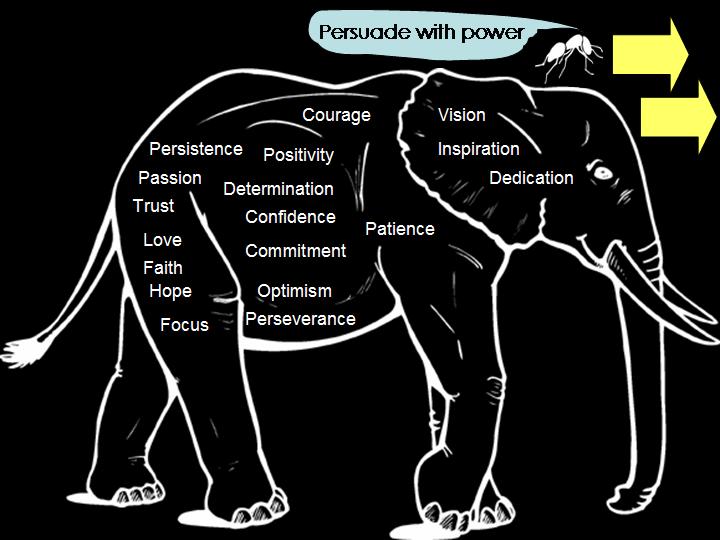
If our conscious mind is like an ant in size, then our unconscious mind is like an elephant. (Vince Poscente used this metaphor in his book The Ant and the Elephant, and in his trainings.)

Imagine an ant, riding on the back of an elephant. It doesn’t matter where the ant wants to go, it would not get there, if the elephant is not going the same way. Let’s say the ant wants to go to the east. No matter how hard and fast the ant walks, if the elephant is walking to the west, the ant will only end up further from his destination.

So, if we want to persuade with power, our unconscious mind must be filled with thoughts associated with passion, faith, and vision. We will not be persuasive, if our unconscious mind is filled with negative thoughts associated with apathy, fear, and hopelessness.

When our words and actions are congruent with our inner world, we will be more persuasive as we are more authentic, credible, and charismatic.

Monday, November 29, 2010

The Magic Question - What Can I Give?

What is the answer to the question, “Who am I, really?”

We ask different questions at different stages of our lives.

At puberty and early childhood, we are preoccupied with questions of identity. We ask, “Who am I, really?”

This is the mother-lode of all questions about our life. It’s not a question we answer by saying, “I’m an engineer” or “I’m a dad.” It’s a question that requires deeper responses, like what I value, what brings me joy, what motivates me, the way I want to live my life.

Many of us never found the answer in our lifetime. Some which we thought were answers led instead to stress, disease, and even tragedies.

I believe we need to ask another question in order to get the answer to this one. We need a bit of reverse engineering.

In their elder years, people look back and ask themselves, had it all been worthwhile? What have I done with my life? Have I contributed anything of lasting value? What’s my legacy?

People tend not to ask these questions when they are young.

We don’t have to wait until we are old before we ask the question, “What have I given?” The earlier we ask the question, “What can I give?” the earlier we become wise enough to know the answer to the question, “Who am I really?”


Gandhi said that the best way to find ourselves is to lose ourselves in the service of others. The answer to “Who am I, really?” has to be found by answering the call “What can I give?”


Many Americans led fulfilling, purposeful lives by answering President Kennedy’s call to his countrymen to ask not what their country can do for them, but to ask what they can do for their country.


We get the most out of life not by taking what we can for ourselves, but by giving to others. Ask yourself - What have I done lately to help people out? Have I been kind to people? Have I been compassionate? Have I been there for anyone? Listened? Volunteered for those in need?


The magic question “What can I give?” is like a switch.

Our life force flows when we ask what we can give.

When we ask "What can I give?" we will look for our talents and gifts. What we look for, we will find. We will live a life of gratitude with an abundance mindset.

Asking the question, “What can I get” only leads to life sapping busyness. We become frantic go-getters.

When we ask "What can I get?" we will be looking for what is missing in our life. We will live a life of stress with a scarcity mindset.

Change your question from “what can I get” to “what can I give” and change your life.

As Aristotle said, your profession is where your talent and the needs of the world meet.

Find yourself, become a go-giver.

Saturday, October 2, 2010

Bounce Back When You Fall


Malaysia's Prime Minister speaking at the ASEAN 100 Leadership Forum yesterday (1st Oct 2010) recounted for his audience his electoral setback in Malaysia's 1999 General Election. That year he very nearly lost his parliamentary seat in his constituency of Pekan - retaining it by a razor thin margin of just 241 votes.

Najib shared: “If you look at 1999, it was a strange situation. My majority dropped to 241.”

It is in trying times like this that the true mettle of a man or woman is revealed.

Frustrated but resolute, Najib worked hard to regain the people’s votes and in the 2004 General Election, won the seat with a whopping majority of 22,922 votes.

In the 2008 General Election, Najib increased the winning margin to 26,464 votes, the highest obtained by any candidate of his political party that year.

Looking back at his dramatic come back with pride, the Malaysian Prime Minister adviced: “If you have the confidence, you should not be deterred by a temporary setback. What is important is the ability to recover. Fortunately, I’m still around."

Wednesday, July 7, 2010

Good Luck or Bad Luck, Too Soon to Tell

Once upon a time in ancient China, there lived an old man and his son who was in his twenties. Father and son tilled the field with their trusty but old and frail horse. This white horse had been part of the family for over ten years, toiling together without complaint with father and son for just a handful of oats every day. Father, son and horse were very attached to one another.

You can imagine the father and son’s dismal when one day, old faithful suddenly bolted towards the hills and disappeared over the horizon. The son chased after the horse but it was too late.

The son threw up his arms in despair, staring at the hills far away, and cried out: “What bad luck! What are we to do now? We have nothing to help us work the fields.”

The old man looked at his son with steady eyes and calmly mused: “Bad luck or good luck, too soon to tell.”

The old man then went to look for ways to plough the field without their horse.

A week had passed since old faithful ran away. Father and son were in the fields working the soil with hoes and their bare hands. It was back breaking work under the scorching sun.

They then heard that familiar neigh in the distance. When they looked up, they saw old faithful on a ridge trotting slowly at first and then galloping towards them.

Old man and son next heard the thunderous hooves of a dozen horses. To their amazement, ten wild horses followed old faithful and ran towards the old man and son’s farm. The herd of wild horses stopped at the farm and were contented to graze on the green, juicy grass.

The wild horses looked young and strong. Their teeth were white and clean. Their eyes were bright. Their thighs were well toned and there was a shiny, healthy sheen on their hide.

When the neighbours saw what happened, they were envious of the old man’s good fortune. They said: “You are such lucky people. Now you have more than ten good and strong horses to work the fields for you.”

The old man smiled politely and said: “Good luck or bad luck, too soon to tell.”

A few days later while the son was taming one of the wild horses, the black stallion stood up on its hide legs and punched its front legs in the air like a boxer - while the son was still on the saddle! The horse’s prancing antics threw the son off its back. He seemed to fly through the air for a moment before falling to the ground like a sack of potatoes with a loud thump!
The son landed on his buttocks. He let off such a loud, shrill, piercing scream that his neighbours could hear and feel his pain from hundreds of metres away . The pain was excruciating. When the neigbhours reached him, they found the son on the ground wrying in agony.

The villagers rushed the son to the doctor and he confirmed that the fall had broken the son’s hip. He was lucky that his neck was not broken.

“What bad luck!” the son cried out. The villagers who knew what happened to the son, took pity on him. "What an unfortunate accident" they said. But the old man remained serene and unfazed. He again mused: “Bad luck, good luck, too soon to tell.”

While the son was still bed ridden, war suddenly broke out with the barbarians in the north. The emperor’s army marched into the village and conscripted all the able bodied young men in the village for the war.
The old man’s son was spared as he could not even stand up with his broken hip.

The war went badly for the emperor and all the young men from the village did not survive to come home.

The old man and his son became the only people left to work the fields of the entire village. Yes, with the help of their ten horses and old faithful.

Is this good luck, or bad? Again the old man said: “Good luck, bad luck, too soon to tell.”

The puzzled and bewildered villagers finally asked the old man to explain his trademark remarks.
The wise old man replied: “Life is like this. Sometimes things that looked bad at first may later turn out to be a blessing in disguise.

Knowing this, it’ll serve us well to look for opportunity in every crisis.

Instead of wallowing in self pity when met with setbacks, ask what benefits can I get out of my current predicament. Ask "What is this an opportunity for?" With this mindset, you’ll find that any bad luck will turn to good luck.

Things happen, and it is what we do with what happens to us that makes the difference.

So the next time something momentous happens to you, stop and pause a moment to choose your course of action instead of letting the situation you are in determine your feelings, and thus your actions.

In the same way, when our situation is rosy, remember that there is danger in every good fortune. Be alert to dangers when things are going well. Don’t be caught off guard, like my son who was thrown from his favourite horse."

"Ah yes" the villagers agreed in unison. 

"Good luck, bad luck, too soon to tell.”